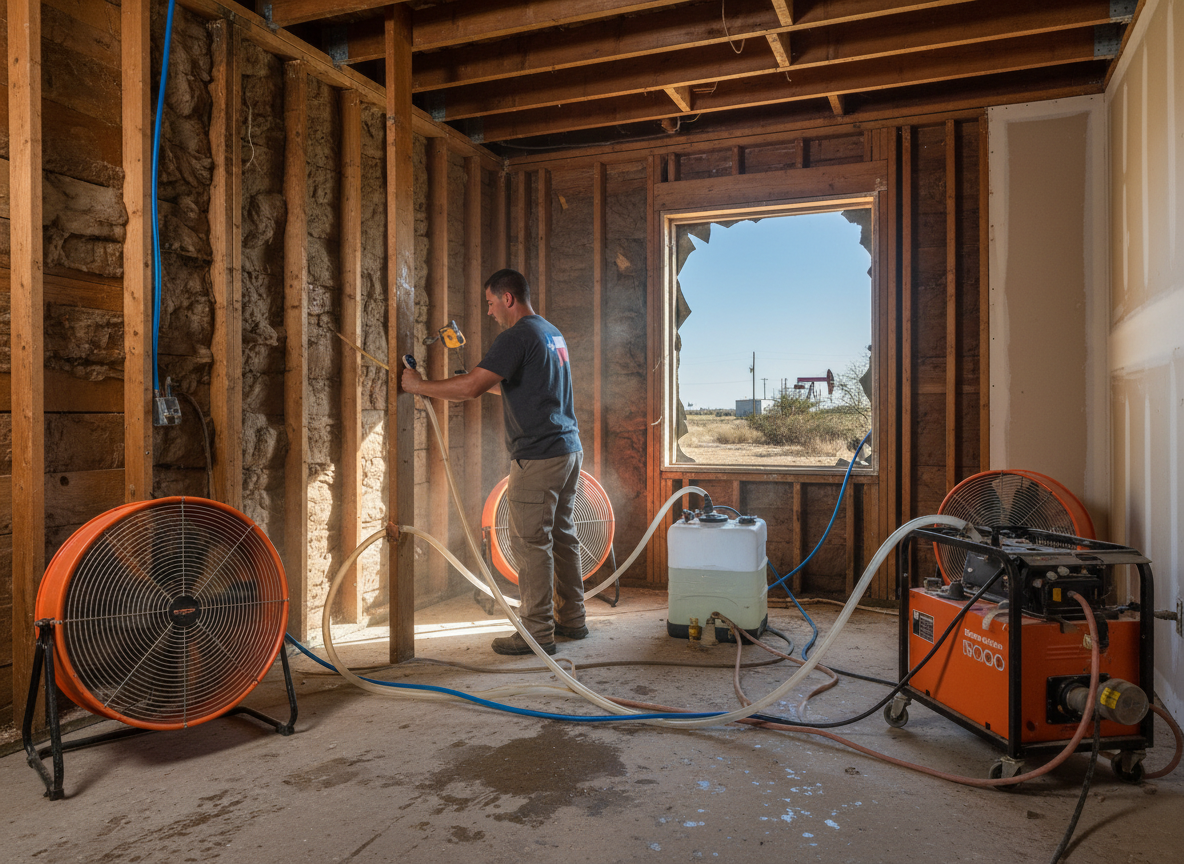
Rockwall homes often feature older wood framing and brick exteriors that trap moisture after flooding from nearby Lake Ray Hubbard storms. Structural drying requires industrial dehumidifiers and air movers placed to pull water from wall cavities and subfloors without demolition where possible. Texas summer humidity above 70 percent extends drying times, so technicians monitor relative humidity daily with meters to avoid hidden mold growth in insulation and behind baseboards.
Clay soils common around Rockwall retain water near foundations, allowing moisture to wick upward into sill plates long after visible water recedes. Edge cases include multi-story properties where upper floors dry slower due to limited airflow, requiring negative pressure setups. Code considerations in Rockwall call for removing saturated drywall below the flood line to meet health standards, and skipping this step risks insurance denials on future claims.
Dehumidification units must be sized to the square footage and initial moisture readings rather than using one-size equipment. Over-drying can crack wood trim while under-drying leaves elevated moisture that reactivates during the next rain. Technicians log readings at multiple depths in flooring and walls to confirm the structure reaches safe levels before reconstruction begins.
Technician insight
In Rockwall the thing that catches most people out with structural drying and dehumidification is assuming box fans and open windows will finish the job after a storm. Clay soil around foundations here keeps pulling moisture back into bottom plates and subfloors for days, and skipping professional dehumidification almost always leads to hidden mold behind baseboards.
Rockwall Home After Heavy Rain
Water entered a single-story brick home near T L Townsend Drive through the garage and utility room. Moisture had wicked into the subfloor and lower wall cavities. Technicians placed dehumidifiers and air movers, monitored readings daily, and confirmed safe levels before the homeowner began repairs.
Structural Drying and Dehumidification Services We Offer
✓Wall Cavity Drying
Forced-air systems reach behind drywall to remove trapped moisture and reduce mold risk in Rockwall framing.
✓Subfloor Dehumidification
Specialized mats and low-grain dehumidifiers pull water from hardwood and carpet padding without full removal.
✓Ceiling and Attic Drying
Targeted equipment addresses moisture in Rockwall attics where heat and humidity slow natural evaporation.
✓Moisture Mapping and Monitoring
Daily meter readings track progress and prevent hidden saturation from returning through foundation contact.
✓Antimicrobial Treatment
Applied after drying to inhibit growth in previously wet cavities common in Texas flood events.
✓Final Dryness Verification
Documented readings confirm structures meet industry standards before any rebuild work starts.
Structural Drying and Dehumidification Cost in Texas, Rockwall
| Service | Typical Range | What Affects It |
|---|---|---|
| Initial Moisture Assessment | $150–$300 | Larger homes or multiple stories increase time required |
| Equipment Setup And Daily Operation | $400–$900 per day | Number of units and duration determined by readings |
| Final Verification And Report | $100–$250 | Includes documentation for insurance |
| Antimicrobial Application | $200–$450 | Applied only to affected structural areas |
Ranges are typical for Texas, Rockwall and confirmed with an exact written quote before any work starts.
How it works
- 1
On-Site Assessment
Technicians measure moisture at multiple points in walls, floors, and ceilings using calibrated meters.
- 2
Equipment Placement
Dehumidifiers, air movers, and containment barriers are positioned based on the home's layout and water migration paths.
- 3
Daily Monitoring
Readings are recorded and equipment adjusted as moisture levels drop to maintain efficient drying.
- 4
Completion Testing
Final verification confirms safe moisture content before equipment removal and handoff to reconstruction.
Pricing
Costs depend on affected square footage, number of rooms, and how long moisture has been present; upfront quotes provided after assessment.