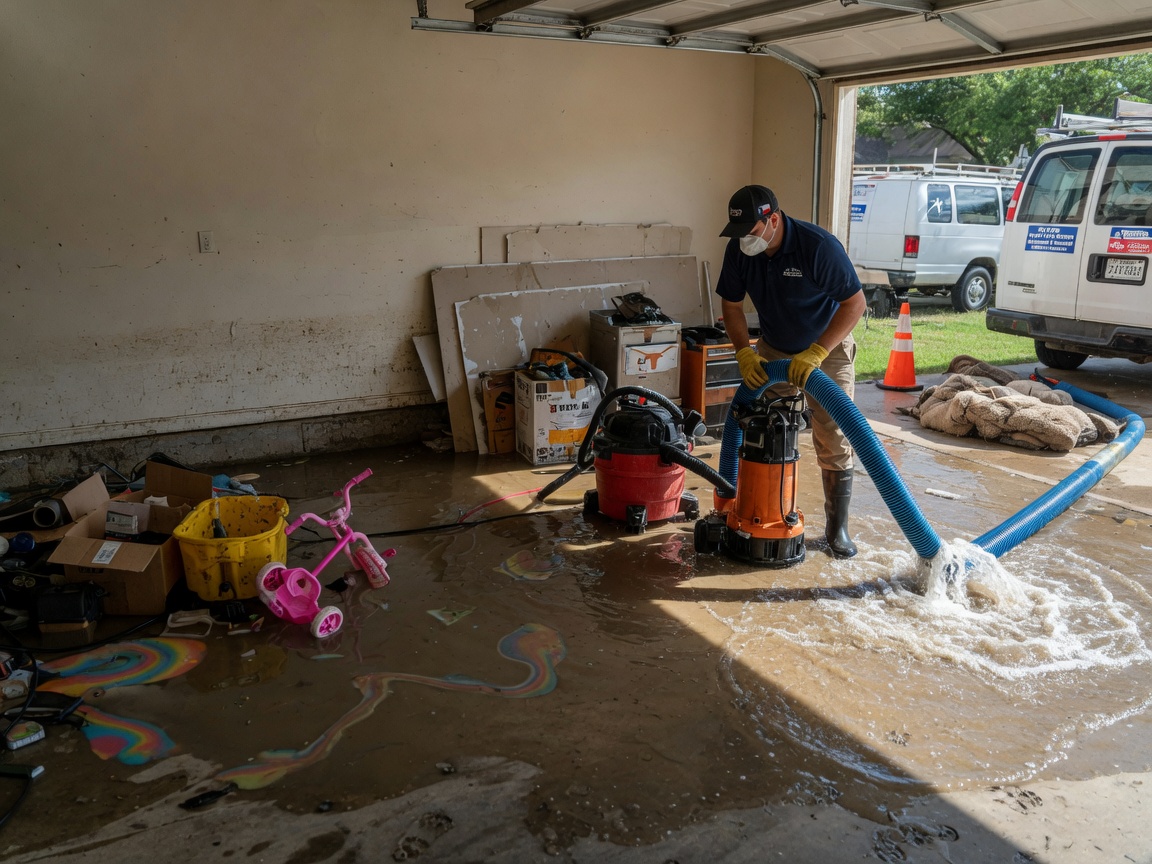
Garages in Rockwall homes often sit at grade with driveways that channel runoff during heavy spring rains common to Rockwall County. Water enters through expansion joints and settles under the slab, where the local clay soil slows natural drainage and keeps moisture against the concrete for weeks. Technicians start by mapping the water line on the slab and checking for hidden pockets behind tool cabinets or under stored vehicles before any pumps are placed.
Once bulk water is removed, dehumidifiers must run long enough to pull moisture from the slab itself because Rockwall’s humidity keeps surface readings high even after visible water is gone. Edge cases include older detached garages with dirt floors that absorb water into the subgrade and newer attached garages where the slab ties into the home foundation, requiring barriers to stop migration into living spaces. Crews also inspect the overhead door seals and weep holes, since blocked drains behind the threshold frequently restart the problem after the first rain.
Homeowners sometimes attempt removal with shop vacs alone, leaving standing water under mats or in the corners where the slab meets the stem wall. That residual moisture feeds mold on stored items and can lift epoxy coatings applied in the last decade. Proper extraction includes pulling base plates on any interior walls and placing air movers at floor level to force evaporation through the joints before sealing or refinishing begins.
Technician insight
In Rockwall the thing that catches most people out with Garage Flood Water Removal is the clay-heavy soil that holds water against the slab edge long after the rain stops. Homeowners often stop once the floor looks dry, yet moisture still migrates up through the control joints and ruins boxes stored against the wall.
Driveway Runoff Into Attached Garage
Heavy rain sent water across a sloped driveway in Rockwall and under the overhead door. The slab stayed damp for days because clay soil blocked drainage. Extraction removed the standing water and drying equipment ran for 48 hours until slab readings dropped. Stored tools and the water heater base stayed dry with no mold later.
Garage Flood Water Removal Services We Offer
✓Garage Slab Water Extraction
Removes standing and trapped water from concrete slabs using submersible pumps and moisture mapping to reach pockets under cabinets and vehicles.
✓Post Flood Garage Drying
Sets up commercial dehumidifiers and air movers sized for the garage volume to pull moisture from the slab and prevent mold growth on stored goods.
✓Garage Threshold Drain Cleaning
Clears debris from door threshold drains and French drains behind the overhead door that commonly back up during Rockwall rain events.
✓Vehicle and Storage Protection
Moves and protects vehicles plus boxed items, then places containment barriers so water does not wick into adjoining living areas.
✓Slab Joint and Seal Repair
Replaces failed expansion joint filler and applies vapor barrier coatings once the slab tests dry to stop future water entry at the same points.
Garage Flood Water Removal Cost in Texas, Rockwall
| Service | Typical Range | What Affects It |
|---|---|---|
| Initial Garage Assessment | $75–$150 | Includes moisture readings and written scope; waived if extraction work follows same day. |
| Water Extraction Visit | $250–$600 | Covers pump time and labor; higher when water sits under heavy storage or vehicles. |
| Slab Drying Equipment Rental | $150–$400 per day | Daily rate for dehumidifiers and air movers; length depends on slab thickness and humidity. |
| Threshold Drain Clearing | $125–$275 | One-time service; price rises if excavation behind the door is required. |
Ranges are typical for Texas, Rockwall and confirmed with an exact written quote before any work starts.
How it works
- 1
Site Assessment
Technician inspects the garage slab, checks water depth, notes entry points from the driveway, and tests for hidden moisture behind stored items.
- 2
Bulk Water Removal
Submersible pumps and wet vacuums extract standing water while protecting electrical outlets and any finished walls inside the garage.
- 3
Targeted Drying
Air movers and dehumidifiers are positioned at floor level to evaporate moisture from the slab and joints until readings reach acceptable levels.
- 4
Final Inspection And Protection
Slab is retested, any new seal work is applied, and homeowners receive guidance on keeping threshold drains clear before the next storm.
Pricing
Cost depends on water depth, slab access, and whether drying equipment must run multiple days.